
AI SYSTEMS
Building modular AI systems for long-term adaptability
Durable AI systems evolve through explicit modules and stable interfaces rather than repeated wholesale rebuilds. Modularity creates the space to adapt—safely, measurably and with accountability—to changing needs over time.
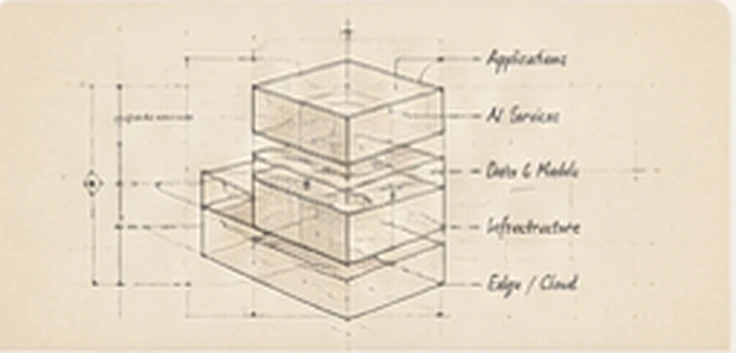
Change is constant: models improve, policies shift, data sources appear and disappear, infrastructure evolves and operational needs mature. Systems built as monoliths struggle to keep pace. Modular architectures—composed of well-defined parts with clear contracts—make change routine instead of risky. This article outlines a practical blueprint for designing, governing and operating modular AI systems that can adapt over the long term.
1. Why adaptability is an architectural choice
Adaptability is not a runtime feature you bolt on later—it is the product of early architectural decisions. When boundaries are implicit and dependencies hidden, every change becomes a system-wide bet.
Models will change. Policies will change. Data sources, compute platforms and infrastructure will change. Even the questions we are asked to answer will change. A modular architecture assumes this and builds in the capacity to evolve.
A system can only adapt safely when change is expected, bounded and observable.
2. The anatomy of a modular AI system
Cross-cutting rails—governance, observability and human oversight—span every layer.
3. Design around contracts, not components
Stable interfaces
Define clear contracts for input, output, behavior and performance. Interfaces are the promise that stays stable while internals evolve.
Replaceable modules
Encapsulate capabilities behind interfaces so modules can be upgraded, swapped or retired without rippling changes.
Explicit dependencies
Declare what each module depends on—versions, data, policies, infrastructure—so impacts are visible before changes are made.
4. What should be separable?

Separate along natural boundaries that change independently or fail independently. Typical candidates include:
5. Change without destabilising the whole
Detect signals in metrics, logs and feedback.
Define change, impact and success criteria.
Validate in isolated environments and canaries.
Human review of risk, evidence and compliance.
Roll out in phases with feature flags.
Monitor outcomes, SLIs and user impact.
Revert the change if thresholds are breached.
Every change is intentional, tested and reversible.
6. Modularity needs governance
Modularity without control leads to hidden coupling, drift and operational fragility. Governance makes modularity safe at scale.
Clear accountable owners for each module and interface.
Semantic versioning for modules, contracts and datasets.
Compatibility rules and change impact analysis before release.
Record decisions, tests, approvals and outcomes as artifacts.
7. Designing for graceful degradation
Systems should continue to deliver value, even when parts degrade.
8. Observability across boundaries
End-to-end visibility creates accountability and speeds learning.
Who, what, when and where.
Inputs, sensor data and state.
Which modules and versions were used.
Rules and policies applied.
Decisions and outputs generated.
Reviews, overrides and annotations.
Results, impacts and feedback.
A complete decision and evidence trail builds trust and supports audits.
Instrumentation must follow the data and decisions across modules. Correlate logs, metrics and traces with business outcomes and human feedback.
Store the artifacts—inputs, versions, policies, outputs and approvals—so results are reproducible and explainable over time.
9. The cost of too much modularity
Excessive fragmentation increases latency, integration burden and cognitive load. It can also duplicate controls and obscure ownership.
10. Before a modular system enters the field
Use this checklist to validate readiness.
Are module boundaries explicit and documented?
Do interfaces have stable contracts and SLIs?
Can modules be tested independently?
Are versions traceable for modules, data and policies?
Can failures be isolated and recovered without cascade?
Is there a safe rollback path for changes in production?
Are human escalation and oversight defined?
Is audit evidence captured end-to-end?
How TAEGIS builds modular AI in practice
The capabilities we bring to organisations that need systems built to evolve.
Our own platform is built as clean, separable modules—facility modelling, assessment, simulation and risk—behind stable interfaces, so each part can evolve without rebuilding the whole.
Gated approvals, stamped sign-offs and audit trails are built into our workflows—every decision, test and release leaves reviewable evidence.
Our systems run air-gapped and offline-first, with layered fallbacks—when parts degrade or links drop, core capability and human control continue.
AI clarity sprints, secure platform builds and responsible-AI operating models—we help you draw the module boundaries and then deliver against them.
11. Adaptability is engineered before change arrives
Modular architectures accept that change is inevitable and design for it. By making boundaries explicit, contracts stable and governance disciplined, we can evolve systems without compromising safety, performance or trust.
The goal is not modularity for its own sake—it is the capacity to adapt responsibly as needs, technology and context evolve.
Govern with discipline.
Evolve with confidence.
Build AI systems that can evolve responsibly
We partner with organisations to design, build and operate modular AI systems that perform today—and adapt for tomorrow.